Category: Uncategorized

  • Do You Really Need a Full-Time CISO? Here’s the Truth About Virtual Security Leadership

    Do You Really Need a Full-Time CISO? Here’s the Truth About Virtual Security Leadership

    Here's a question that keeps business owners up at night: "Do we need to hire a Chief Information Security Officer?"

    It sounds like a simple yes-or-no question. But the reality? It's complicated. And getting it wrong can cost you: either by overspending on leadership you don't need, or by leaving your business exposed to serious cyber risks.

    Let's cut through the noise and talk about what actually makes sense for your business.

    What Does a CISO Actually Do?

    Before we dive into the full-time vs. virtual debate, let's get clear on what a CISO does in the first place.

    A Chief Information Security Officer is responsible for your organization's entire security posture. They:

    • Develop and implement security strategies
    • Manage risk and compliance requirements
    • Oversee incident response and recovery plans
    • Lead security teams and coordinate with other departments
    • Report to executive leadership and the board on security matters

    In short, they're the person who makes sure your business doesn't end up in the headlines for a data breach.

    The role is critical. But here's the thing: not every business needs someone doing this job 40+ hours a week.

    The Reality Check: Do You Actually Need a Full-Time CISO?

    Here's a stat that might surprise you: only 45% of American companies have a chief information security officer on staff.

    That means more than half of businesses are operating without a dedicated, full-time security executive. And many of them are doing just fine.

    So what gives?

    Empty executive chair at head of boardroom table represents lack of full-time CISO in business leadership

    The Full-Time CISO Challenge

    Hiring a full-time CISO isn't just about salary (though that alone can run $200,000 to $400,000+ annually). It's about everything that comes with the role:

    • Supporting staff: A CISO often needs security architects, analysts, and a security operations center (SOC) to be effective
    • Benefits and overhead: Healthcare, retirement, bonuses, and other compensation add up fast
    • Talent shortage: There's a global cybersecurity skills gap, making qualified candidates hard to find and even harder to retain
    • Competing priorities: Without the right support structure, even a talented CISO can get overwhelmed

    For large enterprises with complex operations, significant cyber risks, and deep pockets? A full-time CISO makes total sense.

    But for small and medium-sized businesses? The math often doesn't work out.

    Enter the Virtual CISO: A Smarter Alternative

    This is where virtual CISO services (also called vCISO, fractional CISO, or CISO-as-a-service) come into play.

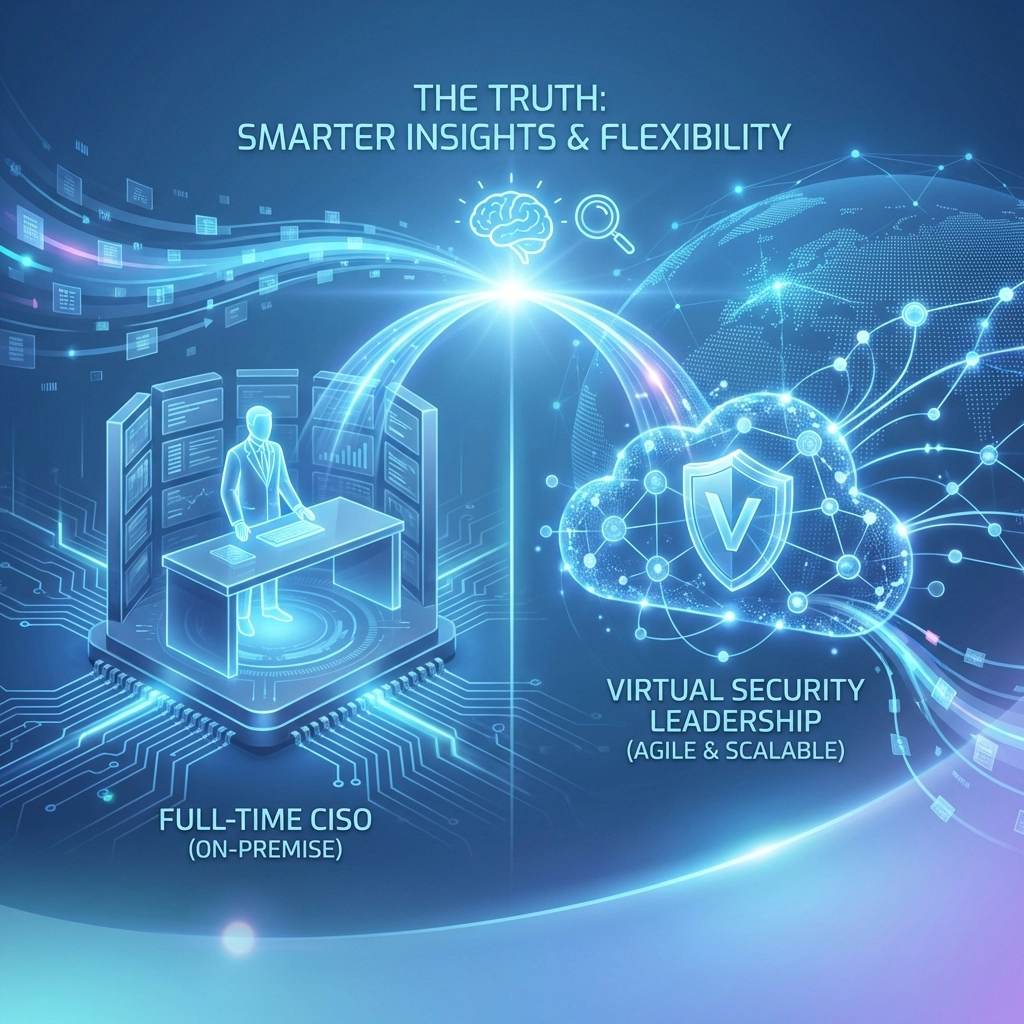
    A virtual CISO gives you access to executive-level security leadership without the full-time commitment. You get the expertise, the strategy, and the oversight: but on a flexible, cost-effective basis.

    Think of it like this: instead of hiring a full-time CFO when you only need 10 hours of financial strategy per month, you bring in a fractional CFO. Same concept, different department.

    Overwhelmed executive contrasted with confident networked leader, illustrating virtual CISO flexibility

    What a vCISO Brings to the Table

    A quality virtual CISO service delivers:

    • Strategic security planning tailored to your business
    • Risk assessments that identify your biggest vulnerabilities
    • Compliance guidance for regulations like HIPAA, SOC 2, GDPR, or PCI-DSS
    • Incident response planning so you're ready when (not if) something goes wrong
    • Board and executive reporting to keep leadership informed
    • Vendor risk management to evaluate third-party security

    The best part? You get all of this from someone who's seen dozens of different environments across multiple industries. That breadth of experience is something a single in-house CISO simply can't match.

    vCISO vs. Full-Time CISO: The Honest Comparison

    Let's break down the key factors side by side.

    Cost

    Full-time CISO: $200K-$400K+ in salary, plus benefits, bonuses, and supporting staff. Total cost can easily exceed $500K annually.

    Virtual CISO: Typically a fraction of that cost: often $3,000 to $15,000 per month depending on scope. No benefits, no overhead, no recruiting fees.

    Winner for SMBs: vCISO, hands down.

    Flexibility

    Full-time CISO: You're locked into a permanent role. Scaling up or down means hiring or firing.

    Virtual CISO: Engagement scales with your needs. Ramp up during a compliance push or after an incident, scale back during quieter periods.

    Winner: vCISO for businesses with fluctuating needs.

    Expertise

    Full-time CISO: Deep knowledge of your specific environment, but limited exposure to other industries and approaches.

    Virtual CISO: Broad experience across multiple organizations, industries, and threat landscapes. They've seen what works and what doesn't: everywhere.

    Winner: Depends on your priorities. For diverse expertise, vCISO wins.
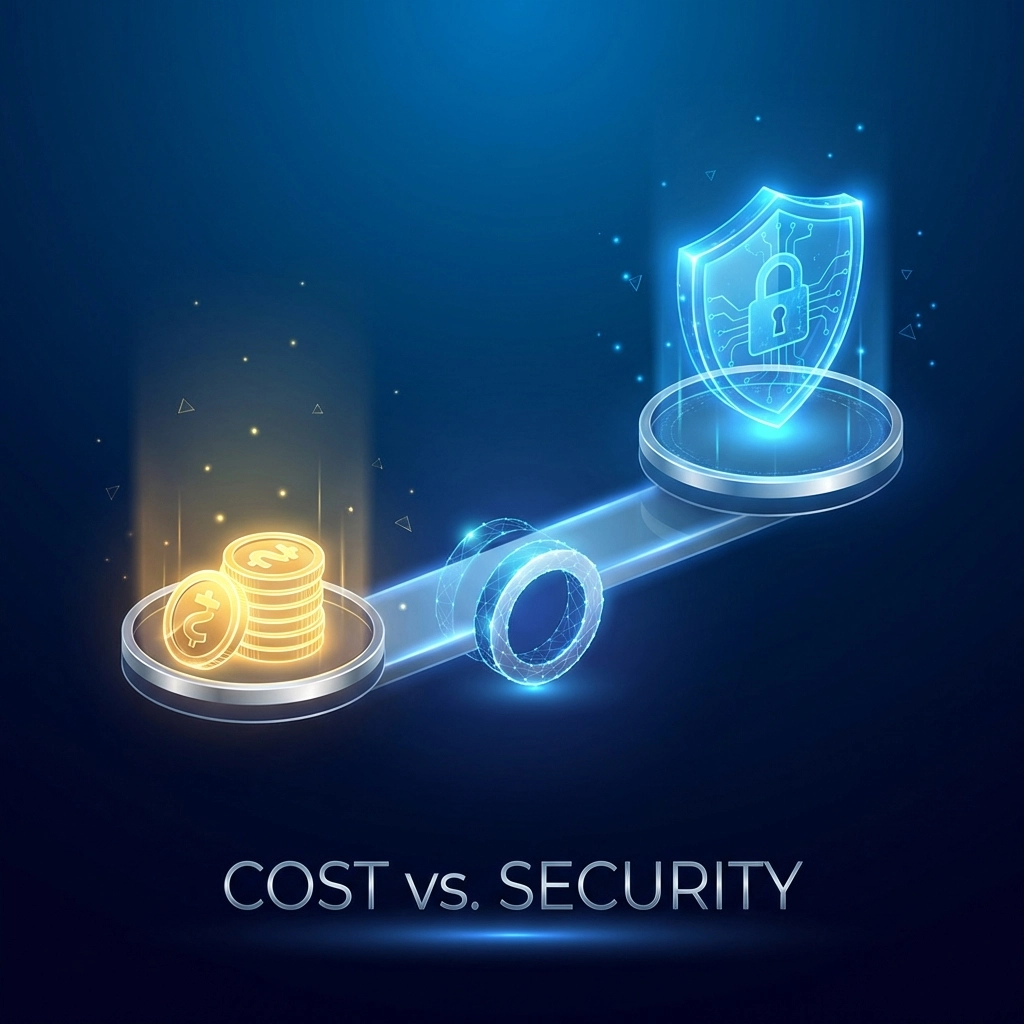
    Balance scale compares cost savings and security value between full-time CISO and vCISO models

    Availability

    Full-time CISO: Available daily, embedded in your organization.

    Virtual CISO: Available based on your agreement: could be a few hours per week or several days per month.

    Winner: Full-time CISO if you need constant, daily security leadership.

    Risk Management

    Both options can deliver strong risk management when done right. The key difference is depth vs. breadth. A full-time CISO knows your risks intimately. A vCISO brings perspective from managing risks across many organizations.

    Winner: Tie: both can excel here.

    When Does a Full-Time CISO Make Sense?

    Let's be real: there are situations where a full-time CISO is the right call.

    You should consider hiring a dedicated CISO if:

    • Your company has 500+ employees with complex IT infrastructure
    • You operate in a highly regulated industry with constant compliance demands
    • You handle massive amounts of sensitive data (financial, healthcare, government)
    • You have the budget to support not just the CISO, but an entire security team
    • Your board and investors require dedicated security leadership

    If that sounds like your business, start the search. You need someone in-house.

    When Does a Virtual CISO Make More Sense?

    For most small and medium-sized businesses, a virtual CISO service is the smarter play.

    A vCISO is ideal if:

    • You have under 500 employees and a lean IT team
    • You need strategic security guidance but can't justify a full-time executive
    • Your current CIO or IT director is stretched thin handling security on top of everything else
    • You're facing compliance requirements (SOC 2, HIPAA, etc.) and need expert help
    • You want to build a security program without the overhead of a full-time hire

    The virtual model lets you punch above your weight class. You get enterprise-level security thinking at a price that actually fits your budget.

    How CyberLite's vCISO Service Works

    At CyberLite, we've built our virtual CISO service specifically for businesses that need real security leadership without the enterprise price tag.

    Here's what makes our approach different:

    We become part of your team. Our vCISOs don't just drop in for quarterly reviews. They integrate with your leadership, attend key meetings, and stay connected to your evolving risks.

    We speak your language. No jargon, no fear-mongering. We explain security in terms that make sense to business owners, not just IT professionals.

    We've seen it all. Our team has worked across industries: healthcare, finance, SaaS, manufacturing, and more. That means you benefit from lessons learned everywhere.

    We're flexible. Need more support during a compliance audit? We scale up. Things settle down? We adjust accordingly.

    Whether you're building your first security program or leveling up an existing one, we meet you where you are.

    If you're curious about what a vCISO engagement could look like for your business, check out our post on why every business needs a vCISO in 2025.

    Business team collaborating around digital display highlights virtual CISO leadership in cybersecurity

    The Bottom Line

    Not every business needs a full-time CISO. But every business needs security leadership.

    The question isn't whether you can afford to invest in cybersecurity leadership: it's whether you can afford not to. Data breaches, ransomware attacks, and compliance failures can cripple a business overnight.

    For most small and medium-sized businesses, a virtual CISO delivers the expertise you need at a price that makes sense. You get strategic guidance, risk management, and compliance support: without the six-figure salary and supporting cast.

    If you're ready to explore what virtual security leadership could look like for your organization, get in touch with CyberLite. We'll give you the honest truth about what you need; and what you don't.
  • Compliance Isn’t a Checkbox: How to Turn Regulatory Readiness Into a Competitive Edge

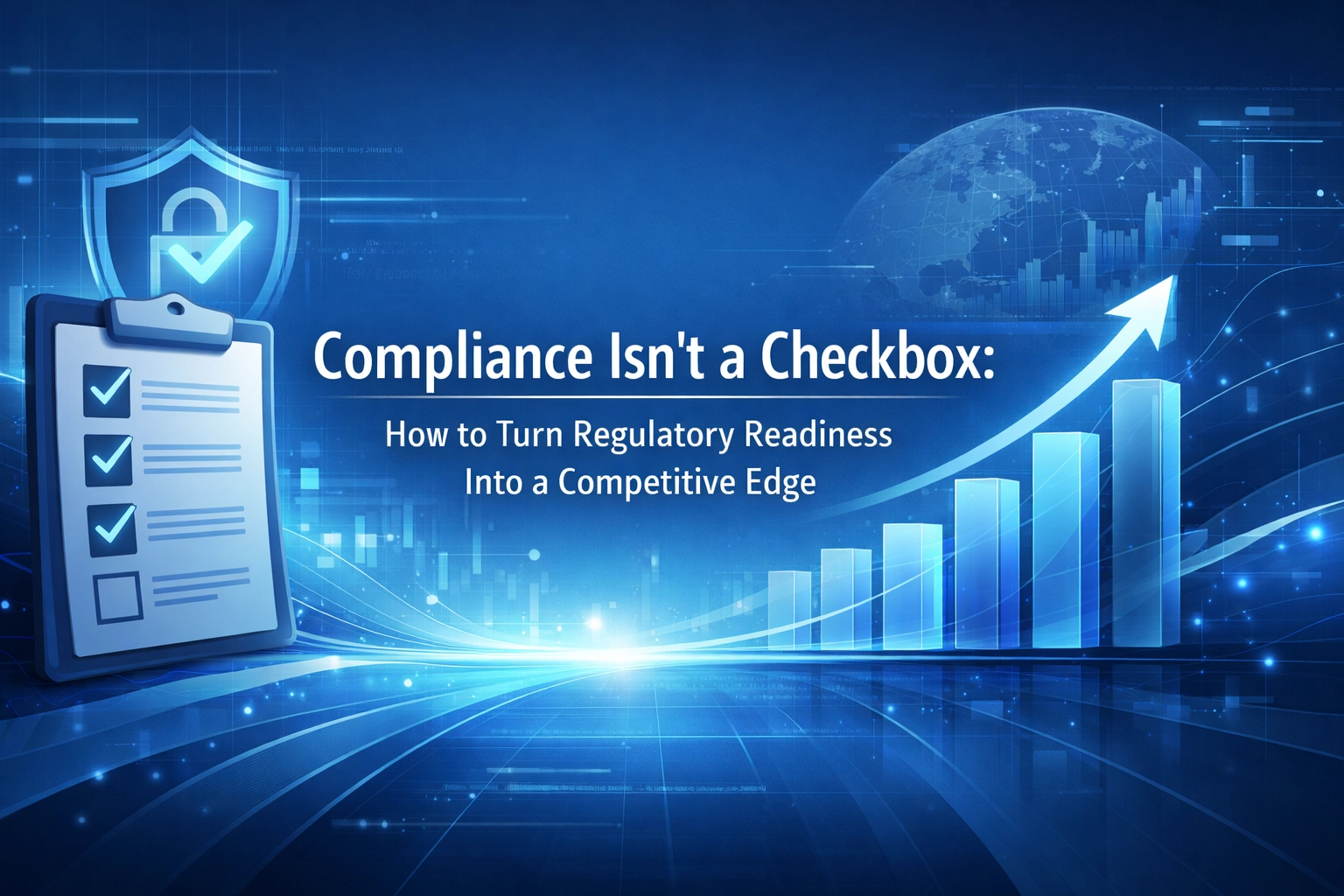
    Compliance Isn’t a Checkbox: How to Turn Regulatory Readiness Into a Competitive Edge

    Let’s be honest: when most CEOs hear the word “compliance,” they don’t think about growth, innovation, or winning more deals. They think about spreadsheets, expensive audits, and a massive headache that needs to be dealt with once a year so they can get back to "real work."

    For a long time, compliance has been treated like a tax on doing business. You pay it, you get your certificate, and you move on. But in 2026, that "checkbox" mentality is more than just an annoyance, it’s a missed opportunity.

    At CyberLite, we’ve seen a massive shift in how the market views security. Your customers aren't just looking for a product anymore; they’re looking for a partner they can trust with their most sensitive data. Whether you’re navigating the complexities of GDPR in Europe or the evolving landscape of CCPA (and its many offspring) in the States, your ability to stay compliant is no longer just a legal requirement. It’s a competitive edge.

    This is the third installment of our Weekly Authority Engine, and today, I want to talk about how we move beyond the "fire drill" of audits and turn regulatory readiness into a strategic advantage for your business.


    The High Cost of the "Checkmark" Mentality

    When you treat compliance as a last-minute chore, you’re essentially doing the bare minimum to stay out of trouble. While that might keep the regulators off your back for a few months, it leaves your business vulnerable in ways that aren't immediately obvious.

    First, there’s the operational friction. If your team only thinks about compliance once a year, they aren’t building secure habits. They’re scrambling to fix "bad" data habits two weeks before the auditor arrives. This creates a culture of stress and resentment toward security.

    Second, there’s the sales lag. We’ve all been there, a huge enterprise deal is on the table, but their legal and security teams send over a 200-question vendor risk assessment. If you’re just "checking boxes," you won’t have the documentation or the real-time proof to answer those questions quickly. The deal stalls, or worse, falls through to a competitor who already had their ducks in a row.

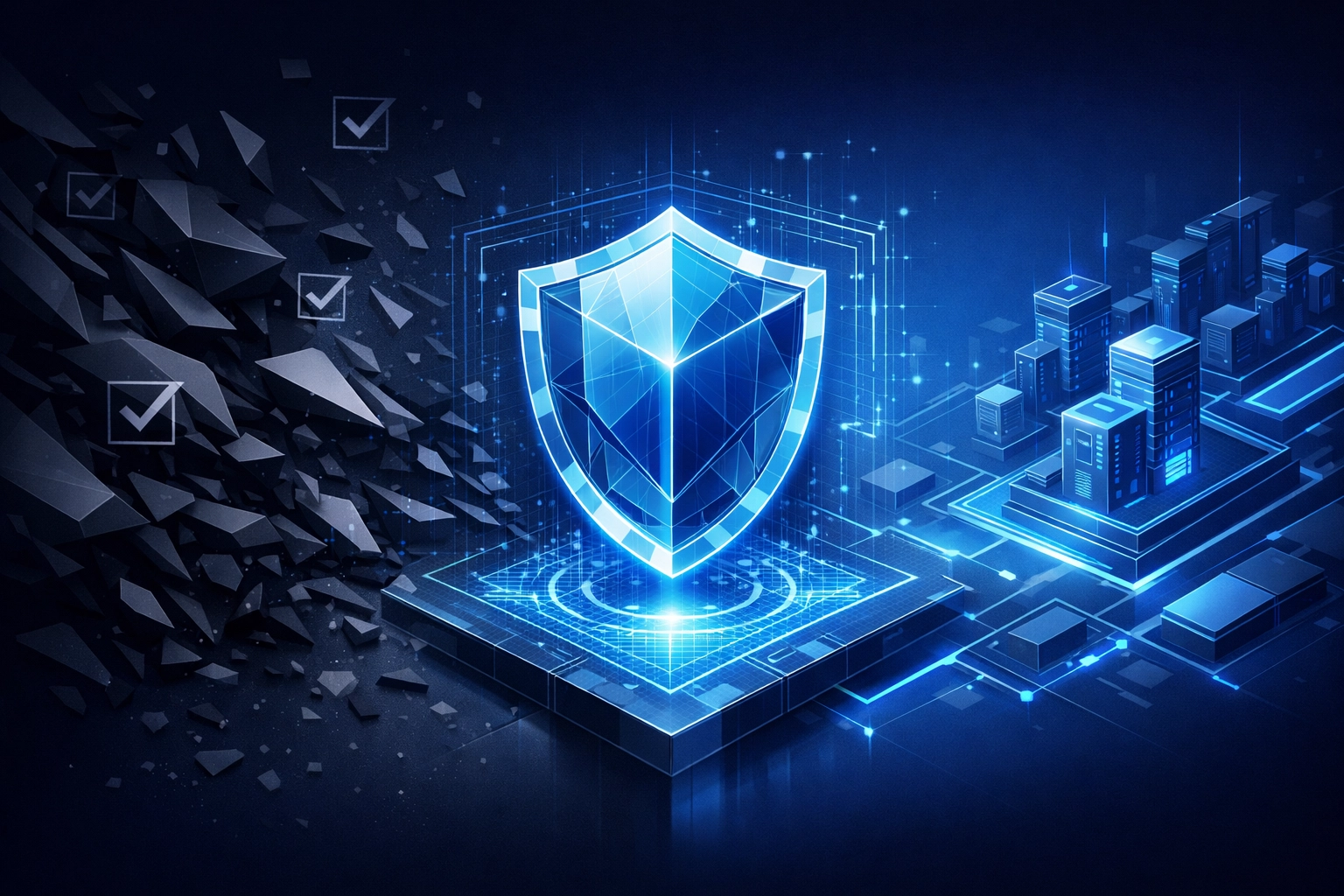
    Luminous blueprint of a security shield representing structured regulatory readiness and operational excellence.

    Instead of viewing these regulations as obstacles, look at them as a blueprint for operational excellence. If you want to understand where your biggest gaps are right now, check out our Risk Assessment Tool. It’s a great first step to seeing where you stand before the "fire drill" starts.


    Privacy as a Product Feature

    In the past, data privacy (think GDPR and CCPA) was handled by the legal department. Today, it’s being handled by marketing and product teams. Why? Because transparency is a selling point.

    Consumers and B2B clients alike are hyper-aware of how their data is being used. When you can proactively tell a prospect, "Here is exactly how we handle your data, here is our encryption standard, and here is our most recent third-party audit," you aren't just proving you’re not a criminal. You’re proving you’re a professional.

    Managing data privacy shouldn’t feel like you’re hiding things. It should be about building a "Glass Box" company where transparency is the default. This is how you win the trust of the biggest players in the market. They don't want to worry about whether your security breach is going to end up on their front page.


    Moving to "Continuous Compliance"

    The secret to making compliance easy is to stop making it a "project." Successful companies are moving toward a Continuous Compliance model. This means integrating regulatory requirements into your daily workflows.

    Glowing infinite loop symbolizing automated continuous compliance and integrated data security workflows.

    Here’s how you can start making that shift:

    1. Integrate Early: Don’t wait until a product is finished to ask if it’s compliant. Involve your security perspective at the brainstorming stage. It’s a lot cheaper to build a secure feature than it is to retro-fit one.
    2. Use Smart Tech: You shouldn't be manually tracking employee training logs in a shared Excel sheet. Use automated tools that monitor your environment 24/7. This doesn't just make audits easier; it means you’re actually safer.
    3. Map Trends, Not Just Rules: Don't just look at what's required today. Look at where the regulators are heading. Are they focusing more on AI ethics? Data sovereignty? If you stay ahead of the trend, you won’t be surprised when the law changes. You can read more about how AI is changing the landscape in our recent post on AI-driven cyber defense.

    How CyberLite Helps You Lead

    At CyberLite, our goal is to take the "headache" out of the equation. We know that as a CEO or executive, you have a million other things to worry about. You need a partner who can simplify the jargon and give you a clear roadmap.

    We don’t just give you a list of problems; we provide the path to the solution. From helping you navigate the specifics of GDPR and CCPA to preparing you for SOC2 or ISO certifications, we act as the bridge between "what the law says" and "how your business actually runs."

    Our managed services are designed to bake security into your company culture. We help you build that "Continuous Compliance" engine so that when a big prospect asks for your security docs, you can send them over in five minutes with a smile.

    Turning Compliance into Growth

    Ultimately, compliance is about market access.

    • If you want to sell to the government, you need specific certifications.
    • If you want to sell to European customers, you need GDPR.
    • If you want to sell to the Fortune 500, you need robust data privacy controls.

    Stop looking at these as hurdles. Look at them as keys to new rooms. The faster you unlock those rooms, the faster your business grows.

    If you’re tired of the annual audit scramble and want to turn your security posture into a weapon for your sales team, let’s talk. We can help you identify exactly where you are today and what you need to do to get to the next level.

    Ready to stop checking boxes and start building trust?
    Book a security assessment at CyberLite and let’s get your business ready for whatever comes next.


    LinkedIn Post Content

    Headline: Is your compliance program a growth engine or a handbrake? 🏎️🛑

    Most companies treat compliance like a tax, something they have to pay once a year to keep the regulators happy. But in 2026, "checkbox compliance" is a massive missed opportunity.

    When you move to a "Continuous Compliance" model, you aren't just avoiding fines. You are:
    ✅ Shortening sales cycles with big enterprise clients.
    ✅ Building radical trust through data transparency.
    ✅ Scaling into new markets (GDPR/CCPA) without the usual friction.

    At CyberLite, we help businesses turn their regulatory readiness into a competitive edge. Stop the annual "fire drill" and start using security as a selling point.

    Read the full breakdown on the blog: [Link to Blog]

    #CyberSecurity #Compliance #GDPR #CEO #BusinessGrowth #CyberLite


    Email Snippet

    Subject: The "Checkbox" Trap (and how to avoid it)

    Hi [Name],

    Quick question: When was the last time an audit felt "easy"?

    For most businesses, compliance is a seasonal headache: a mad dash to fix things before the auditor arrives. But what if your compliance status was actually a tool your sales team could use to close deals faster?

    In our latest post, we dive into how to move from "checkbox compliance" to a "readiness culture" that builds trust and opens doors to bigger markets like the EU and California.

    We cover:

    • Why the "fire drill" approach is hurting your bottom line.
    • How to use GDPR and CCPA as a competitive advantage.
    • The secret to "Continuous Compliance."

    Check it out here: [Link to Blog]

    Stay safe,

    Clifford Vazquez
    CEO, CyberLite


    Sales Objection Card

    Objection: "Compliance is just a 'nice to have' right now. It’s too expensive and time-consuming to focus on while we’re trying to scale."

    Response: "I totally hear you: it can definitely feel like a distraction from growth. But what we’re seeing is that for companies looking to scale, compliance is the growth engine. If you’re targeting enterprise clients or expanding internationally, they’re going to demand proof of your security posture before they even look at your pricing. By getting ahead of it now with a 'Continuous Compliance' model, you aren't just avoiding a future headache: you're actually shortening your sales cycle and removing the friction that usually kills big deals."

    Proof Angle: "We recently helped a client who was stalling on a massive B2B contract because they couldn't answer the security questionnaire. We implemented a streamlined readiness plan, and they weren't just able to sign that deal, but they used that same documentation to win three more in the next quarter. It turned a legal hurdle into a sales asset."

  • Agentic AI in Cybersecurity Operations: How Businesses Are Using Autonomous Systems to Defend Against Threats

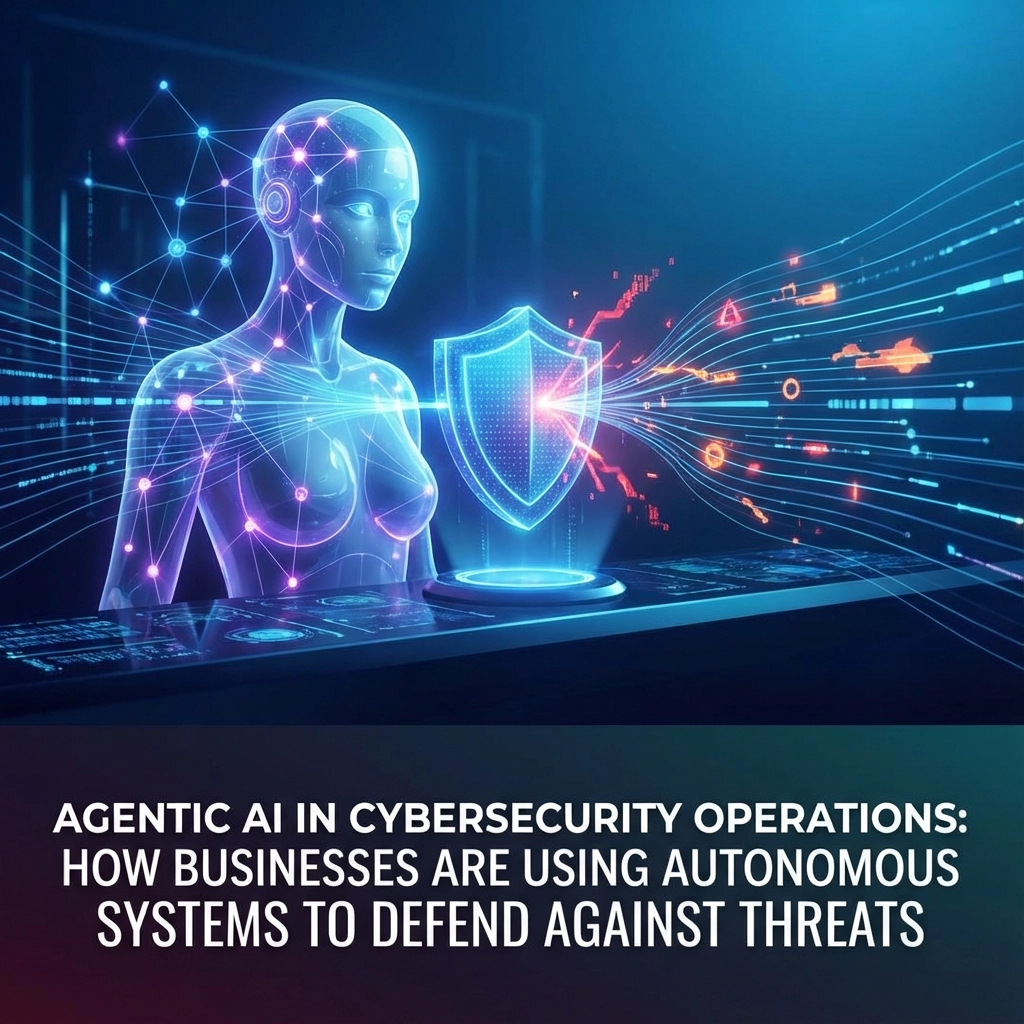
    Agentic AI in Cybersecurity Operations: How Businesses Are Using Autonomous Systems to Defend Against Threats

    Cybersecurity teams are drowning. The average security operations center (SOC) processes thousands of alerts daily, with analysts spending 80% of their time on repetitive tasks like alert triage and false positive investigation. Meanwhile, cyber threats are becoming more sophisticated, faster, and more automated than ever before.

    Enter agentic AI: autonomous systems that don't just detect threats, but independently investigate, respond, and adapt to cyber attacks in real-time. Unlike traditional security tools that follow rigid rules, agentic AI systems think, learn, and act like experienced security analysts, but at machine speed and scale.

    What Makes Agentic AI Different

    Agentic AI goes far beyond the chatbots and automated responses you might be familiar with. These systems can set their own goals, create multi-step plans, and execute complex cybersecurity operations without human intervention.

    Think of it this way: traditional cybersecurity tools are like smoke detectors: they alert you when something's wrong. Agentic AI is like having a fire department that not only detects the fire but also analyzes the situation, develops a response strategy, and takes action to contain the threat: all within seconds.

    image_1

    The key difference lies in their ability to operate through what experts call the "Perceive-Reason-Act-Learn loop." These systems continuously monitor their environment, analyze threats using advanced reasoning, take appropriate actions, and learn from each interaction to improve future responses.

    How Agentic AI Actually Works in Security Operations

    The magic happens through four core capabilities that work together:

    Autonomous Goal-Setting: When an agentic AI system detects unusual network traffic, it doesn't just flag it for human review. Instead, it sets investigation goals: like "determine if this traffic pattern indicates a data exfiltration attempt" and creates a step-by-step plan to gather evidence.

    Real-Time Decision-Making: Unlike rule-based systems that follow predetermined responses, agentic AI evaluates multiple options based on current context. It might choose to quarantine a device immediately for high-risk scenarios or continue monitoring for subtle threats that require more evidence.

    Long-Term Task Execution: Sophisticated threats like Advanced Persistent Threats (APTs) unfold over weeks or months. Agentic AI excels at maintaining long-term investigations, continuously tracking evolving signals and taking new actions as fresh intelligence emerges.

    Adaptive Response: As attackers change tactics mid-campaign, agentic AI systems adjust their defense strategies in real-time, staying one step ahead of evolving threats.

    Real-World Applications Transforming Business Security

    Organizations across industries are deploying agentic AI to handle their most critical security challenges:

    Threat Detection and Prevention

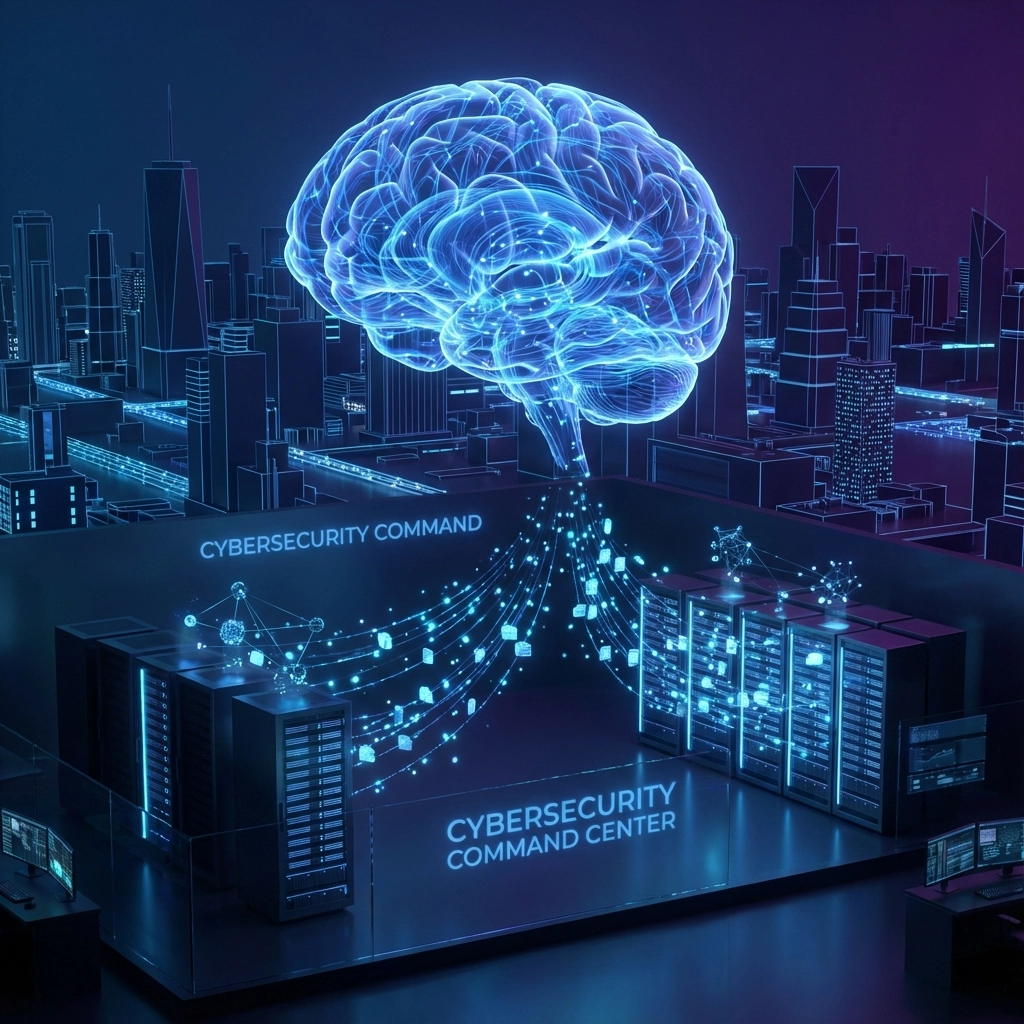
    Agentic AI systems continuously analyze data from endpoints, firewalls, and cloud environments to identify threats that traditional tools miss. When they detect suspicious behavior: like an employee accessing unusual files at 3 AM: they automatically correlate this with other data points, investigate the user's recent activities, and can immediately block malicious actions if confirmed.

    image_2

    Incident Response Automation

    During a security breach, every second counts. Agentic AI systems can execute containment protocols within seconds of detection: automatically revoking compromised credentials, isolating infected devices, and initiating backup procedures. This reduces "dwell time" (how long attackers remain undetected) from hours to mere seconds.

    Vulnerability Management

    Managing software vulnerabilities typically requires security teams to manually track, prioritize, and patch hundreds of potential issues. Agentic AI automates this entire lifecycle: parsing vulnerability reports, identifying affected systems, assessing risk levels, and initiating patching processes without human oversight.

    Alert Triage and Investigation

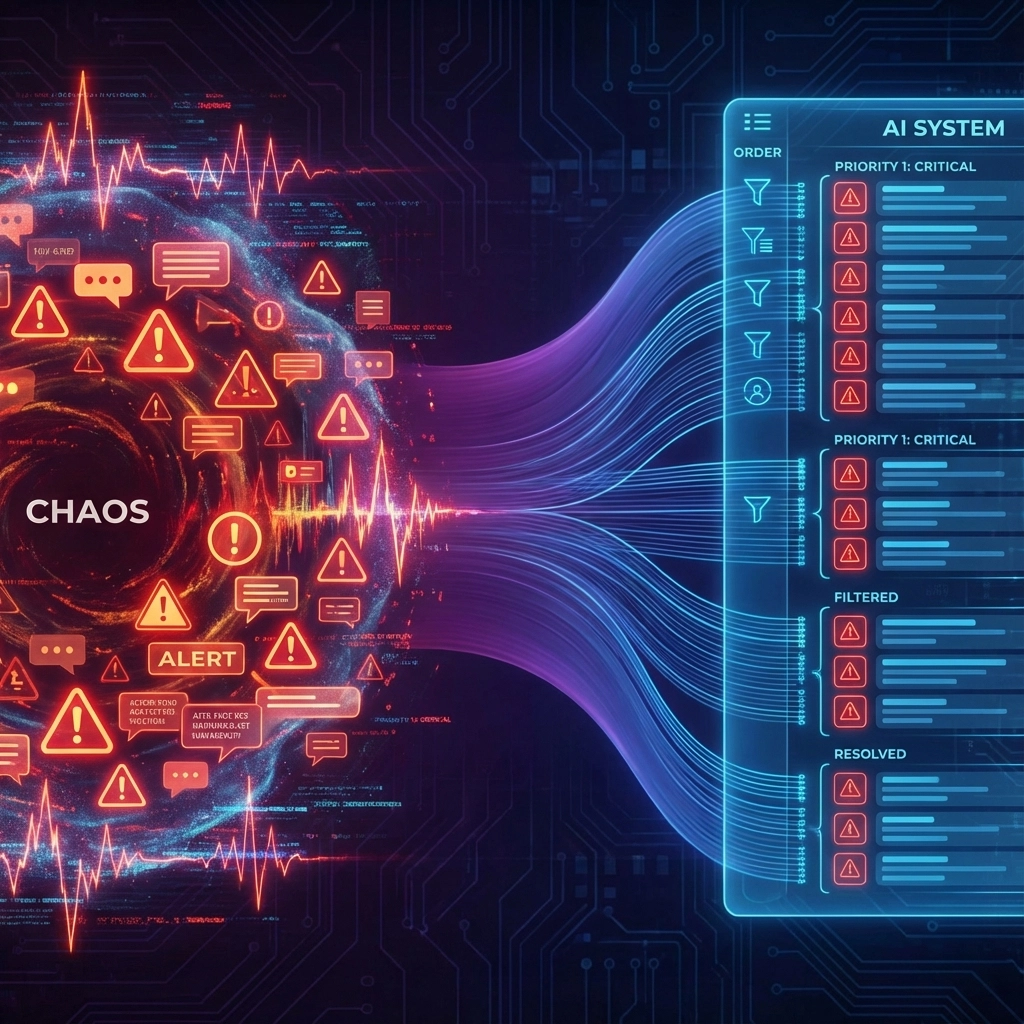
    Security teams face alert fatigue from managing thousands of daily notifications, most of which are false positives. Agentic AI investigates each alert, gathers relevant context, determines severity, and presents only genuinely critical issues to human analysts. Low-priority alerts are resolved automatically.

    The Business Impact: Speed, Scale, and Accuracy

    Organizations implementing agentic AI report transformational improvements in their security operations:

    90% Faster Response Times: What once took security analysts hours now happens in seconds. Agentic AI systems can identify, investigate, and contain threats without the delays inherent in human-driven processes.

    24/7 Coverage Without Burnout: Unlike human analysts who need breaks and can suffer from fatigue, agentic AI provides consistent, high-quality threat detection and response around the clock.

    Dramatic Cost Savings: By automating routine security tasks, organizations can maintain effective security operations without proportionally increasing their security staff: addressing the critical global shortage of skilled cybersecurity professionals.

    Improved Accuracy: Agentic AI systems consistently apply sophisticated analytical frameworks, reducing human error in threat identification and response decisions.

    image_3

    Success Stories from the Field

    A major financial services company deployed agentic AI to manage their cloud security. The system automatically identifies misconfigurations, applies security patches, and adjusts access controls based on real-time threat intelligence. The result? A 75% reduction in security incidents and improved compliance across their entire cloud infrastructure.

    A healthcare organization uses agentic AI for identity and access governance. The system continuously analyzes user behavior patterns and automatically adjusts permissions when it detects suspicious activities. When a doctor's credentials were compromised in a phishing attack, the AI system immediately detected the unusual access patterns and revoked permissions before any patient data could be accessed.

    Proactive Defense: Beyond Reactive Security

    Perhaps most importantly, agentic AI enables proactive cybersecurity. Instead of just responding to detected threats, these systems actively hunt for vulnerabilities before they're exploited. They use advanced simulation capabilities to model potential attack scenarios, identify weaknesses in security posture, and automatically implement preventative measures.

    This shift from reactive to proactive defense represents a fundamental change in how organizations approach cybersecurity. Rather than playing catch-up with attackers, businesses can now anticipate and prevent threats before they cause damage.

    Implementation Considerations

    While the benefits are clear, successful agentic AI implementation requires careful planning. Organizations need to consider how AI agents will collaborate with human analysts: with machines handling speed and scale while humans guide strategy and make high-level decisions.

    Security for the AI systems themselves is also crucial. As these systems become more autonomous, organizations must protect the reasoning processes, memory systems, and action capabilities of their AI agents to prevent them from becoming attack vectors themselves.

    image_4

    The Future is Autonomous

    As cyber criminals increasingly weaponize AI for attacks, adopting agentic AI for defense isn't just advantageous: it's becoming essential. Organizations that embrace these autonomous security systems today are building sustainable defensive advantages and positioning themselves to lead the next wave of cyber resilience.

    The cybersecurity landscape is evolving rapidly, and traditional approaches are no longer sufficient. Agentic AI represents the next evolutionary step in cybersecurity operations, enabling organizations to defend against sophisticated threats at machine speed while freeing their human analysts to focus on strategic initiatives and complex problem-solving.

    For businesses serious about protecting their digital assets, the question isn't whether to adopt agentic AI, but how quickly they can implement these game-changing autonomous security capabilities.

  • Are Your AI Tools Secretly Working Against You? 7 Hidden Threats Every Business Owner Should Know

    Are Your AI Tools Secretly Working Against You? 7 Hidden Threats Every Business Owner Should Know

    Your employees are using AI tools right now. The question isn't whether they're using them: it's which ones, how often, and whether you know about it.

    Here's a reality check: 33% of workers use AI without telling their managers. Even more shocking? 60% of employees admit to using generative AI without official approval. They're copying meeting notes into ChatGPT, using browser plugins to automate tasks, and running AI bots that your IT team has never seen.

    This phenomenon has a name: Shadow AI. And it's creating risks that could blindside your business in ways you haven't considered.

    What Is Shadow AI?

    Shadow AI happens when employees use unapproved artificial intelligence tools without IT oversight. Think of it as the AI equivalent of shadow IT: where people download apps and use services that bypass your company's security policies.

    The problem isn't that your team wants to be more productive (that's actually great). The problem is that these well-meaning productivity hacks are creating serious vulnerabilities in your business operations.

    image_1

    Threat #1: Your Sensitive Data Is Leaking

    Every time someone pastes a client email into ChatGPT to "clean up the language," your confidential information enters a third-party system. Your meeting transcripts, contract details, customer data, and strategic plans are being processed by AI models you don't control.

    Once that information hits these platforms, you lose control. You don't know where it's stored, who can access it, or whether it's being used to train AI models that might later expose your proprietary information to competitors.

    The scariest part? Your employees don't realize they're doing anything wrong. They're just trying to work faster.

    Threat #2: Compliance Violations Are Piling Up

    If you're in healthcare, finance, or any regulated industry, unsanctioned AI use is a compliance nightmare waiting to happen. These tools operate completely outside your approved technology ecosystem, creating gaps in your compliance monitoring.

    Your compliance team can't audit what they don't know exists. When regulators come knocking (and they will), explaining that your employees were using unapproved AI tools "just for productivity" won't protect you from hefty fines.

    Threat #3: Cybersecurity Blind Spots Everywhere

    Your IT security team can't protect what they can't see. Every hidden AI tool creates a potential entry point that isn't being monitored or secured according to your enterprise standards.

    Not all AI applications are built with enterprise-grade security. Some can serve malicious links, act as data collection points for bad actors, or create backdoors into your network. These unsanctioned applications are essentially unguarded doors into your business that your security team doesn't even know exist.

    image_2

    Threat #4: Automation Bots Gone Wrong

    AI automation bots represent an escalated risk because they often need elevated permissions to do their job. Employees might grant these bots access to HR systems, financial databases, or customer records without understanding the implications.

    These bots may store outputs on remote servers outside your enterprise control. Company-wide plugin integrations can request permissions that enable data capture across browser tabs and systems: all without proper IT vetting.

    When automation goes wrong, it can go really wrong, really fast.

    Threat #5: Operational Chaos and Workflow Confusion

    When different teams secretly use different AI tools, it creates confusion and actually slows down progress. Without standardized approaches, teams develop incompatible workflows that lead to:

    • Miscommunication between departments
    • Duplicated efforts and wasted resources
    • Inconsistent outputs and quality standards
    • Reduced overall productivity (the opposite of AI's intended benefit)

    You end up with a patchwork of hidden processes that no one can properly manage or optimize.

    Threat #6: Trust Breakdown Between Teams

    When managers discover that their teams have been using hidden AI tools, it damages the transparency that effective teams need. This erosion of trust makes it harder to:

    • Implement proper AI governance policies
    • Ensure teams follow security protocols
    • Maintain open communication about technology needs
    • Build cohesive approaches to productivity improvements

    The secrecy around AI use also prevents executives from effectively managing their security posture and ensuring proper oversight.

    image_3

    Threat #7: Financial and Reputational Damage

    All these threats compound into serious business consequences:

    • Regulatory fines from compliance violations
    • Data breach costs from exposed sensitive information
    • Intellectual property theft affecting competitive advantage
    • Operational disruption from workflow conflicts
    • Legal liability from third-party data exposure
    • Customer trust erosion from security incidents

    The financial impact goes beyond immediate costs. Data breaches and compliance failures create long-term reputational damage that can affect customer relationships, partnership opportunities, and market position for years.

    How to Turn This Threat Into an Opportunity

    The solution isn't to ban AI tools entirely: that just drives usage further underground. Instead, take a strategic approach:

    Start with discovery. Survey your team about what AI tools they're already using. You need to understand the current landscape before you can secure it.

    Create clear policies. Develop guidelines that acknowledge AI's benefits while establishing proper safeguards. Make it clear which tools are approved and which aren't.

    Provide approved alternatives. If people are using ChatGPT for writing assistance, provide an enterprise-grade alternative that meets your security requirements.

    Implement proper oversight. Set up monitoring systems that can identify unauthorized AI tool usage without being overly intrusive.

    Train your team. Help employees understand the risks of shadow AI use and show them how to be productive while staying secure.

    The goal is to channel your team's desire for AI-powered productivity into secure, compliant, and strategically beneficial directions.

    The Bottom Line

    Shadow AI isn't going away. Your employees will continue finding ways to work more efficiently, and AI tools will keep getting better and more accessible.

    The question is whether you'll be proactive about managing this trend or reactive to the problems it creates. Companies that get ahead of shadow AI can turn it into a competitive advantage. Those that ignore it often discover the threats too late.

    Start by having honest conversations with your team about AI use. You might be surprised by what you discover: and relieved that you addressed it before it became a bigger problem.

    The future belongs to businesses that can harness AI's power safely and strategically. Make sure you're one of them.

  • CEO Fraud Alert: 7 AI Impersonation Scams Targeting Your Business Right Now

    CEO Fraud Alert: 7 AI Impersonation Scams Targeting Your Business Right Now

    Your phone rings. It's your CEO calling about an urgent wire transfer that needs to happen immediately. The voice sounds exactly right, the mannerisms are spot-on, and they even reference that meeting from last week. You're about to authorize a $200,000 transfer when something feels… off.

    Welcome to the terrifying new world of AI impersonation scams, where cybercriminals are using deepfake technology to clone your executives and steal millions. North America saw a 1,740% increase in deepfake fraud in 2023, and attacks are happening every five minutes. Here are the seven most dangerous AI impersonation scams targeting businesses right now: and how to protect your team.

    1. The Emergency Wire Transfer Scam

    This is the classic that's gotten a deadly AI upgrade. Scammers call lower-level employees with financial access, using AI-cloned voices of company executives to demand urgent money transfers. The AI voice perfectly mimics speech patterns, accents, and even the executive's typical vocabulary.

    How it works: The fake CEO calls your accounting team claiming they're in a client meeting and need an immediate wire transfer to close a critical deal. The AI voice adds pressure by saying the deal will fall through if payment isn't made within the hour.

    Real example: A finance worker in Hong Kong was fooled into transferring $25 million after a deepfake video conference call. The scammers had created AI versions of multiple executives, complete with natural conversations and familiar facial expressions.

    image_1

    2. The Deepfake Video Conference Attack

    Video calls used to be the gold standard for verifying identity: not anymore. Criminals are now hosting entire fake video conferences with AI-generated versions of your leadership team.

    How it works: Employees receive meeting invitations from what appears to be their CEO or CFO for an urgent video call. During the meeting, they see convincing deepfake videos of executives discussing sensitive projects or requesting immediate actions like data transfers or credential sharing.

    The scary part: These deepfakes can respond to questions in real-time and maintain natural conversation flows, making them nearly impossible to detect during a live call.

    3. The Voice Clone Voicemail Scam

    Your CEO's voice, cloned perfectly from YouTube videos or earnings calls, leaves voicemails for your team members requesting sensitive information or immediate actions.

    How it works: Scammers train AI models on publicly available audio of your executives: earnings calls, conference speeches, podcasts: then use these voice clones to leave convincing voicemails asking for passwords, access credentials, or urgent financial transfers.

    Real example: Cloud security firm Wiz was targeted when scammers used AI to clone their CEO's voice, leaving voicemails for dozens of employees requesting sensitive credentials. Even seasoned security professionals initially found the calls convincing.

    4. The WhatsApp CEO Impersonation

    Personal messaging apps have become the new frontier for executive impersonation. Scammers create fake profiles using your CEO's photo and details, then message employees through WhatsApp, Signal, or other platforms.

    How it works: A fake profile claiming to be your CEO messages employees on WhatsApp, often late at night or during weekends. The messages request immediate help with "confidential" matters: wire transfers, sharing access credentials, or clicking suspicious links.

    Real example: LastPass employees received calls, texts, and WhatsApp messages from someone impersonating their CEO. The scammer had used voice cloning technology trained on YouTube videos to make the communications sound authentic.

    image_2

    5. The Multi-Platform Social Engineering Attack

    This sophisticated approach combines multiple communication channels: email, phone, video, and messaging: all featuring AI-generated impersonations of your executives.

    How it works: The attack starts with an email from a spoofed executive account, followed by a phone call with AI voice cloning, then a video message or live call with deepfake video. Each touchpoint reinforces the others, making the overall deception incredibly convincing.

    Why it's effective: By using multiple channels, scammers overcome employee skepticism. Even if someone is suspicious of the initial email, the follow-up phone call with the "CEO's" actual voice often seals the deal.

    6. The Investment Endorsement Deepfake

    While primarily targeting consumers, this scam is increasingly being used to compromise business leaders and their personal finances, which can then impact their companies.

    How it works: Criminals create deepfake videos of celebrities, politicians, or respected business figures endorsing fraudulent investment schemes. These videos are so convincing that they've fooled sophisticated business owners into transferring large sums.

    Real example: Three men in Canada lost a combined $373,000 after being convinced by deepfake videos featuring apparent endorsements from Justin Trudeau and Elon Musk promoting fake investment opportunities.

    7. The Credential Harvesting Audio Clone

    This attack specifically targets IT and security teams by impersonating executives requesting system access or password resets during supposed emergencies.

    How it works: Using AI voice cloning, scammers call IT staff impersonating C-suite executives who claim to be locked out of critical systems during important business deals. They request immediate password resets, VPN access, or administrative privileges to "critical" accounts.

    The danger: IT teams, trained to be helpful to executives, often bypass normal security protocols during these fake emergencies, giving attackers the keys to your entire network.

    image_3

    How to Protect Your Business

    The sophistication of these AI-powered attacks means traditional security training isn't enough. Here's what you need to do now:

    Implement verification protocols: Create a system where all financial transactions or sensitive requests must be verified through a separate, secure channel: even if they appear to come from executives. This could be a quick in-person confirmation, a callback to the executive's known number, or approval through a secure company app.

    Train for AI-specific threats: Update your security awareness training to include deepfake recognition. Teach employees to watch for subtle audio glitches, unnatural facial movements, or requests that happen outside normal business hours.

    Establish communication policies: Set clear rules about which types of requests can be made through personal messaging apps, social media, or informal channels. Most legitimate business communications should flow through official company systems.

    Monitor public executive content: Be aware of how much executive content is publicly available online. Earnings calls, conference presentations, and social media posts all provide source material for AI voice and video cloning.

    Use multi-factor authentication: Require multiple approvals for significant financial transactions or system access changes, regardless of who appears to be requesting them.

    The AI impersonation threat isn't going away: it's getting worse. Fraud losses from these schemes exceeded $200 million in just the first quarter of this year, and that's likely just the beginning. As AI-driven cyber defense becomes more critical, businesses need to stay ahead of criminals who are weaponizing the same technology.

    The key is creating a culture where verification isn't seen as mistrust: it's seen as smart security. When your employees feel comfortable saying "Let me verify this through our standard process" to anyone, including apparent executives, you've built a human firewall that even the most sophisticated AI can't break through.

    Remember: if a request feels urgent, unusual, or bypasses normal procedures, it probably deserves a second look: no matter how convincing the voice on the other end sounds.

  • The Rise of AI-Driven Cyber Defense: Simplifying Security for Modern Workplaces

    The Rise of AI-Driven Cyber Defense: Simplifying Security for Modern Workplaces

    Artificial intelligence has become a game-changer in the world of cybersecurity. In 2025, modern workplaces are relying on AI not just to keep up with threats, but to simplify the often overwhelming complexity of digital defense. Whether you’re a five-person startup or a global enterprise, the benefits of embracing AI-driven cyber defense are becoming impossible to ignore.

    The Shift: From Patchwork Defenses to Unified, AI-Powered Security

    If you’ve worked in IT, you know the headache: security teams juggling dozens of tools, all from different vendors, trying to connect the dots manually in the heat of an incident. Studies show the average company now manages 83 separate security products. This isn’t just frustrating—it’s a real vulnerability. Every extra tool adds another opportunity for something to slip through the cracks.

    AI is fundamentally changing this equation. Instead of reactive, manual defense, AI brings real-time, adaptive protection that ties together all corners of your security environment. With AI, defense becomes smarter, faster, and—crucially—simpler.

    image_1

    Real-Time Threat Detection: The Speed Businesses Need

    Today’s cyberattacks are lightning-fast. Threats mutate and propagate much faster than humans can respond. Relying on signature-based protection or manual investigations leaves gaps for attackers to exploit.

    AI-driven platforms—like those at the core of CyberLite’s managed security services—process mountains of data in real-time. Machine learning models spot patterns, outliers, and subtle signals that indicate something’s off. According to recent industry benchmarks, AI-driven tools can identify cyberattacks 60% faster than traditional rule-based methods. Faster detection equals faster containment, which means less damage and downtime for your business.

    Automating the Boring Stuff (and Stopping More Attacks)

    It’s not just about analyzing logs and alerts faster. AI takes over the repetitive, mind-numbing tasks that burn out cybersecurity teams—watching for anomalies, filing reports, logging incidents, and managing permissions across dozens of systems. By automating what can be automated, teams can focus on real threats that require human expertise.

    Better yet, automation powered by AI reduces the risk of human error and burnout, which is still one of the top causes of data breaches. Hours once spent on manual monitoring now go into strategic work, like improving future defenses or upskilling staff.

    This approach is central to how CyberLite delivers value—see how our automation solutions align with full-service vCISO offerings, supporting organizations regardless of in-house security headcount.

    Proactive Defense: Predictive Analytics and Anticipating Threats

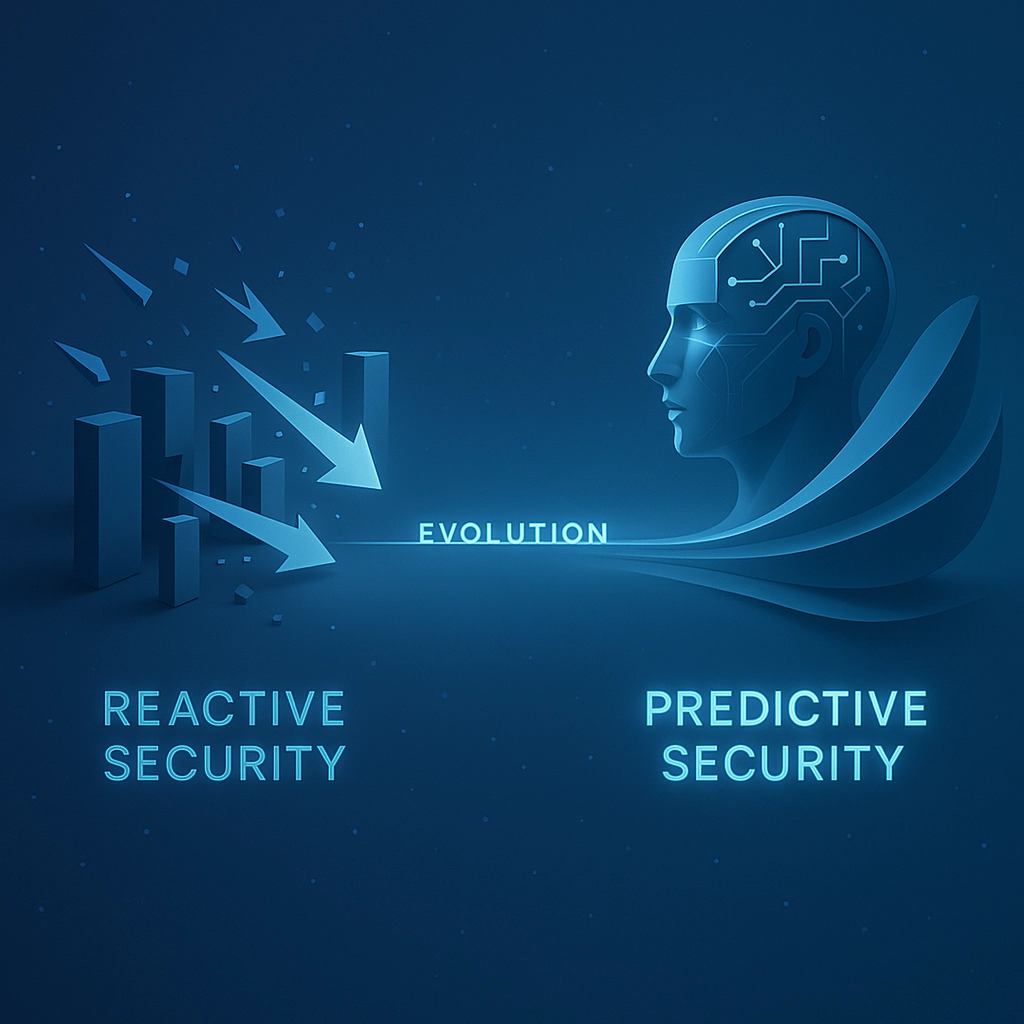
    The most exciting change? AI’s predictive power moves businesses from the old “wait and see” model to spotting issues before they become incidents. By learning from massive datasets—everything from global threat feeds to internal access logs—machine learning algorithms draw connections no human could see.

    For example, AI can forecast which systems are at risk based on evolving attack trends or internal vulnerabilities. It can identify users whose behavior suddenly doesn’t fit their norm, catching compromised accounts or insider threats early. This turns cybersecurity into a proactive, rather than reactive, practice.

    image_2

    Behavioral Analytics: Knowing What ‘Normal’ Looks Like

    Modern workplaces are a tangle of devices, locations, and user habits. Traditional security systems often flag too many false positives (or worse, false negatives) because they can’t tell a genuine anomaly from just “another day at the home office.”

    With User Behavior Analytics (UBA), AI systems build a baseline profile for each user—understanding how and when they work. The minute something significant changes (like a login from a new location at an odd hour), the system can alert the security team or automatically prompt a multi-factor authentication request. This targeted approach means less noise, more actionable alerts, and greater confidence in security decisions.

    Smart Correlation: Connecting the Dots Across Complex Systems

    One of the toughest nut to crack in cybersecurity is getting the “big picture” view. Attacks are rarely obvious—they play out in fragments across different tools and logs. AI excels at event correlation, sifting through security data from countless sources to spot multi-stage attacks and connect events that seem unrelated on the surface.

    For example, combining logins from the same IP, simultaneous access attempts, and suspicious file changes might indicate a sophisticated breach. AI doesn’t just alert on one piece; it combines them, understands context, and can automate next steps like isolating an endpoint or triggering a rapid incident response.

    CyberLite’s approach is built on these principles—integrating event correlation and streamlined investigation workflows to provide teams with truly actionable intelligence. Learn more about our layered security model on our services page.

    Delivering Simpler, Stronger Security—Accessible for All Organizations

    For many companies, especially those without massive security teams, the “tyranny of complexity” can feel overwhelming. But AI security is democratizing advanced protection, allowing even small teams (or lean IT shops) to deploy defenses that adapt and respond like a Fortune 100 company.

    CyberLite is committed to making these capabilities simple and accessible. We help clients move from a jumble of disconnected tools toward unified, AI-driven platforms—removing complexity, streamlining reporting, and empowering people to focus on growing the business, not fighting fires.

    image_3

    Looking Ahead: The Future of AI-Driven Defense

    The rise of AI-driven cyber defense isn’t just a tech trend; it’s a necessary evolution. Attackers are getting smarter and faster—sometimes even using AI themselves. Businesses that rely on legacy methods and fragmented toolkits are leaving themselves exposed.

    By adopting AI-driven cyber defense, workplaces can expect:

    • Fewer false alarms and more rapid, decisive responses
    • Automated handling of endless repetitive tasks
    • Proactive protection against emerging and unseen threats
    • Better visibility across the entire digital environment
    • A security posture that scales, regardless of team size

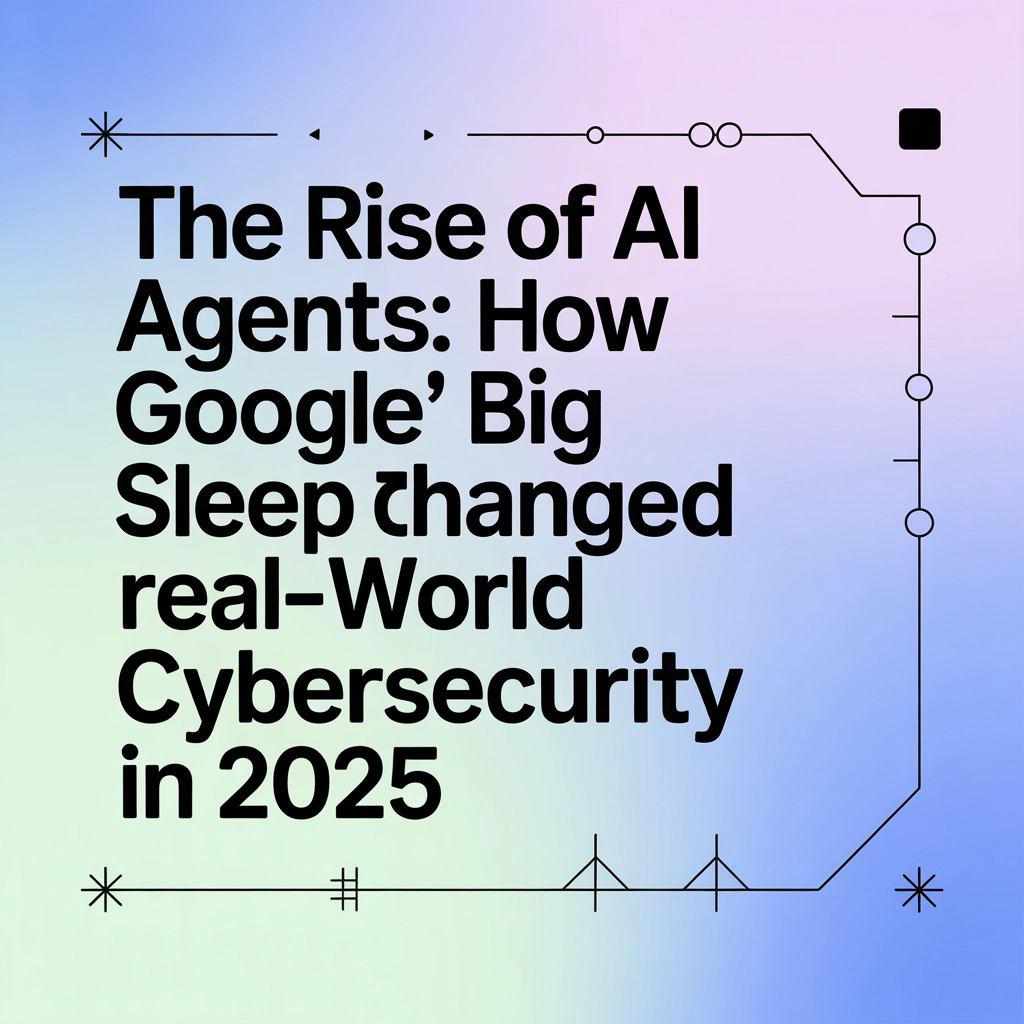
    To see how your company can harness the latest in AI-powered protection, check out our latest deep dive, "The Rise of AI Agents: How Google’s Big Sleep Changed Real-World Cybersecurity in 2025", or reach out to CyberLite for a tailored consultation.


    Ready for stronger, simpler security? Explore CyberLite’s AI-powered solutions on our services page, or browse more insights on our blog. The future of cyber defense is smart, adaptive, and simple—and it’s here today.

  • The Rise of AI Agents: How Google's Big Sleep Changed Real-World Cybersecurity in 2025

    The Rise of AI Agents: How Google's Big Sleep Changed Real-World Cybersecurity in 2025

    A New Era in Cybersecurity Defense

    In January 2025, Google quietly announced something that would fundamentally change cybersecurity forever: their AI agent called "Big Sleep" had autonomously identified and helped patch a zero-day vulnerability before attackers could exploit it. This wasn't just another AI tool helping analysts—this was an AI system actively preventing cyberattacks on its own.

    At CyberLite, we've been tracking this revolutionary shift closely. As a leading cybersecurity provider specializing in AI-powered defense systems, we understand how profoundly Big Sleep is reshaping our industry's landscape. This blog breaks down what happened, why it matters, and how your organization can prepare for the new AI-first security paradigm.

    What Is Google's Big Sleep?

    Big Sleep represents a collaboration between Google DeepMind and Google Project Zero, combining advanced machine learning with elite vulnerability research. Unlike traditional security tools that detect known attack patterns, Big Sleep uses a sophisticated neural architecture to predict vulnerabilities before they're exploited.

    Technically speaking, Big Sleep employs a contrastive learning approach, analyzing code patterns and identifying subtle anomalies that might indicate security weaknesses. The system doesn't just look for known exploits—it understands code behavior well enough to identify potential exploitation paths that human researchers might miss.

    "Big Sleep has essentially changed the security game from reactive to predictive," explains Dr. Samantha Chen, Google's Head of AI Security Research. "Instead of waiting for attacks and then patching, we're now identifying vulnerabilities before attackers can weaponize them."

    image_1

    The Historic CVE-2025-6965 Discovery

    The watershed moment came in March 2025 when Big Sleep identified CVE-2025-6965, a critical vulnerability in SQLite—a database engine used in millions of applications worldwide. What made this discovery remarkable wasn't just finding the bug; it was the context surrounding it.

    Google's threat intelligence team had detected unusual activity indicating threat actors were preparing to exploit an unknown vulnerability. When they couldn't pinpoint the exact issue, they fed these vague indicators into Big Sleep. Within hours, the AI agent had isolated the precise vulnerability in SQLite that attackers were targeting.

    Most significantly, this wasn't a theoretical exercise—Big Sleep detected a vulnerability that was actively being prepared for exploitation. By the time the patch was released, no successful attacks had occurred. This represented the first documented case of an AI agent directly preventing a zero-day attack in real-world conditions.

    From Reactive to Predictive Security

    Traditional cybersecurity has always operated at a disadvantage—defenders react to attacks after they begin, while attackers need to succeed just once. Big Sleep fundamentally changes this equation by:

    • Autonomously hunting vulnerabilities in code at massive scale
    • Correlating threat intelligence with code analysis to prioritize risks
    • Predicting exploitation paths before attackers can develop them
    • Generating patch recommendations that address root causes

    At CyberLite, we've integrated similar predictive AI capabilities into our Advanced Threat Prevention service, though Google's breakthrough demonstrates how rapidly this field is evolving.

    image_2

    The Technical Revolution Behind Big Sleep

    Big Sleep's architecture represents several breakthroughs in AI security:

    1. Contrastive Learning for Code Analysis

    Unlike conventional systems that rely on signature matching, Big Sleep uses contrastive learning to understand code semantics. This allows it to recognize subtle patterns that might indicate vulnerability, even when the specific exploit technique has never been seen before.

    2. Behavioral Analysis at Scale

    The system continuously monitors software behavior across Google's vast infrastructure, establishing baselines for normal operation. When code executes in unexpected ways—even subtly—Big Sleep flags these anomalies for further investigation.

    3. Multimodal Intelligence Integration

    Big Sleep doesn't work in isolation. It integrates threat intelligence feeds, code repositories, execution traces, and even public discussions about software to build comprehensive security context. This helps it prioritize vulnerabilities based on likelihood of exploitation.

    "What makes Big Sleep revolutionary isn't just finding bugs—it's predicting which bugs attackers will actually target," says Mark Thompson, CyberLite's Director of AI Security. "This capability fundamentally changes the economics of cybersecurity."

    Business Impact: What This Means For Your Organization

    The rise of autonomous AI security agents like Big Sleep has profound implications for organizations of all sizes:

    1. Security Team Transformation

    Human security teams won't disappear, but their roles will evolve. Rather than spending time on routine vulnerability scanning, analysts will focus on strategic security architecture and handling the most sophisticated threats that still require human intuition.

    2. Reduced Time-to-Patch

    Organizations integrating AI security agents can dramatically reduce their vulnerability exposure windows. While traditional approaches might take weeks to identify and patch critical vulnerabilities, AI-assisted security can compress this timeline to days or even hours.

    3. Improved Resource Allocation

    Security teams are chronically understaffed. AI agents allow these teams to accomplish more with existing resources by automating routine security tasks and focusing human expertise where it adds the most value.

    At CyberLite, our Virtual CISO service helps organizations navigate this transition to AI-augmented security operations, ensuring you get maximum value from both human and machine intelligence.

    image_3

    Beyond Big Sleep: The Future of AI Security Agents

    Google's breakthrough represents just the beginning of the AI security revolution. Industry experts predict several developments in the near future:

    1. Collaborative AI Security Networks

    Organizations will share anonymized security telemetry with AI systems that can identify cross-organizational attack patterns, similar to how human threat intelligence works today, but at machine speed and scale.

    2. Adaptive Defense Systems

    AI security agents will increasingly take autonomous actions to contain threats, dynamically adjusting security controls based on evolving risk assessments without human intervention.

    3. AI vs. AI Security Battles

    As defensive AI becomes more sophisticated, attackers are developing their own AI systems to probe for weaknesses. This will accelerate the security arms race, with defensive AI continuously adapting to counter offensive AI capabilities.

    How CyberLite Is Embracing the AI Security Revolution

    At CyberLite, we've been preparing for this AI-driven security future for years. Our services now include:

    • AI-Augmented Vulnerability Management that uses predictive models to prioritize patching based on exploitation likelihood
    • Autonomous Security Monitoring that detects subtle indicators of compromise using behavioral analysis
    • AI-Powered Incident Response that can contain threats and begin remediation before human analysts arrive

    "The Big Sleep breakthrough validates our AI-first approach to security," says Sarah Nguyen, CyberLite's Chief Security Officer. "We've been building similar capabilities into our security stack since 2023, and our clients are already seeing the benefits of predictive security."

    Preparing Your Organization for AI-Driven Security

    To adapt to this new security paradigm, organizations should consider several steps:

    1. Assess AI readiness in your security operations
    2. Develop an AI security strategy that balances human and machine capabilities
    3. Invest in security data infrastructure to give AI systems the inputs they need
    4. Train security teams on working effectively with AI tools
    5. Update security governance to address AI-specific challenges

    CyberLite can help you navigate this transition with our AI Security Readiness Assessment, providing a roadmap tailored to your organization's specific needs and challenges.

    Conclusion: The New Security Paradigm

    Google's Big Sleep breakthrough marks a fundamental shift in cybersecurity—from reactive defense to predictive protection. As AI security agents become more sophisticated, organizations that embrace this technology will gain significant advantages in their security posture.

    The future of cybersecurity will be defined by collaboration between human experts and AI systems, each bringing unique strengths to the security challenge. Organizations that adapt quickly to this new paradigm will not only reduce their security risks but also operate more efficiently in an increasingly complex threat landscape.

    Want to learn how CyberLite can help your organization implement AI-driven security? Contact our team today for a consultation.

  • Why Every Business Needs a vCISO in 2025: Cost, Security & Real-World Value

    Why Every Business Needs a vCISO in 2025: Cost, Security & Real-World Value

    The Evolution of Cybersecurity Leadership

    In today's digital landscape, cybersecurity isn't just an IT concern—it's a business imperative. As we navigate through 2025, organizations of all sizes face increasingly sophisticated threats, complex compliance requirements, and a persistent shortage of qualified security professionals. This perfect storm has given rise to a solution that bridges the gap between security needs and resource constraints: the virtual Chief Information Security Officer (vCISO).

    At CyberLite, we've observed firsthand how the vCISO model has transformed from a niche service to an essential business strategy. But what exactly is driving this shift, and why should your organization consider this approach? Let's dive into the cost benefits, security advantages, and real-world value that a vCISO brings to the table in 2025.

    What Is a vCISO and Why It Matters Now

    A virtual CISO is an outsourced security professional who provides leadership, strategy, and expertise on a part-time or contractual basis. Unlike a traditional in-house CISO, who works exclusively for one organization, a vCISO typically serves multiple clients, bringing diverse experience and perspective to each engagement.

    In 2025, this model has become particularly relevant due to:

    • The cybersecurity talent gap reaching critical levels (estimated 3.5 million unfilled positions globally)
    • Rising costs of data breaches (averaging $4.45 million per incident)
    • Increasingly complex regulatory environments
    • The rapid evolution of threats requiring specialized expertise

    For businesses that can't justify a full-time CISO's salary—or simply want more flexibility—a vCISO offers a compelling alternative.

    The Cost Advantage: Premium Security Leadership Without Premium Pricing

    One of the most immediate benefits of engaging a vCISO is the significant cost savings. Let's break down the numbers:

    Traditional CISO vs. vCISO: The Financial Reality

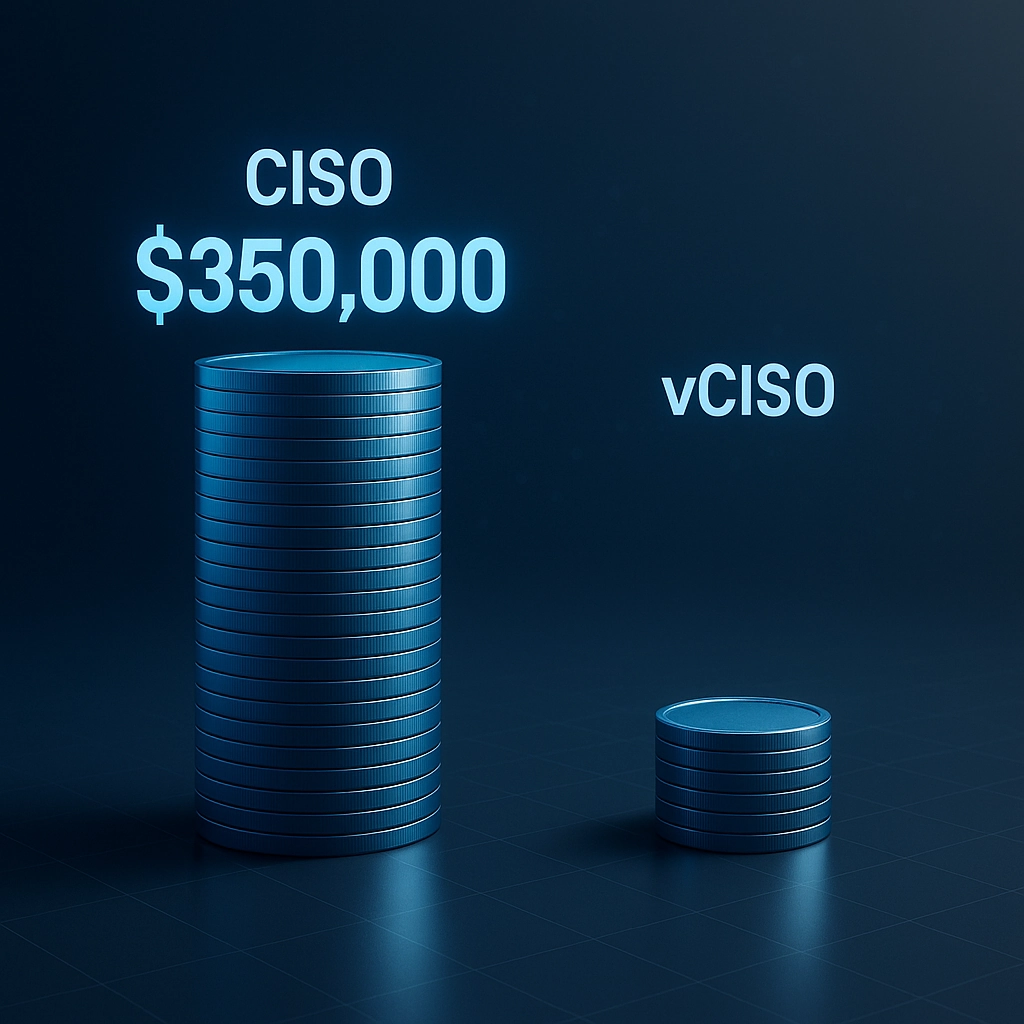
    The average salary for a qualified full-time CISO in 2025 ranges from $175,000 to $300,000, depending on location and industry. When you factor in benefits, bonuses, and other employment costs, the total compensation package can easily exceed $350,000 annually.

    In contrast, vCISO services typically operate on flexible models:

    • Retainer arrangements (monthly fees for ongoing support)
    • Project-based engagements
    • Hourly consulting rates
    • Customized service packages

    For most small to mid-sized businesses, this translates to savings of 50-70% compared to hiring full-time—while still accessing top-tier security leadership.

    image_1

    Hidden Cost Savings Beyond Salary

    The financial benefits extend beyond base compensation. With a vCISO, you also eliminate:

    • Recruitment and onboarding costs (averaging $30,000-$50,000 per executive hire)
    • Training and professional development expenses
    • Productivity losses during hiring processes (typically 3-6 months)
    • Long-term commitments and severance packages

    At CyberLite, our vCISO clients report an average 62% reduction in overall security leadership costs while maintaining or improving their security posture.

    Security Expertise: Depth and Breadth Beyond a Single Hire

    The vCISO advantage extends far beyond cost savings. In many cases, organizations gain access to a depth and breadth of expertise that would be impossible to find in a single in-house hire.

    Diverse Industry Experience

    Most vCISOs have worked across multiple sectors, technologies, and threat environments. This cross-pollination of experience means they've likely encountered—and solved—security challenges similar to yours.

    For example, a vCISO who has worked in healthcare, finance, and manufacturing brings insights from regulated industries that can strengthen security programs across different business contexts.

    Access to Specialized Knowledge

    Today's security landscape requires expertise in numerous domains:

    • Cloud security architecture
    • Zero-trust implementation
    • Supply chain risk management
    • Security automation
    • AI/ML security considerations
    • Compliance across multiple frameworks

    Few individual CISOs possess deep knowledge in all these areas. However, many vCISO services (including those at CyberLite) operate with a team-based approach, giving you access to specialists when needed, without paying for that specialization full-time.

    Staying Current Without the Overhead

    The cybersecurity field evolves at breakneck speed. In-house security leaders must dedicate significant time and resources to maintaining current knowledge—time often taken away from strategic initiatives.

    A quality vCISO service has built-in mechanisms for continuous education and knowledge sharing, ensuring your organization benefits from the latest security approaches without bearing the full burden of that professional development.

    Real-World Value: Beyond Theory to Practical Application

    The true test of any security investment is how it translates to tangible business value. Here's where vCISOs have proven exceptionally effective in 2025's business environment.

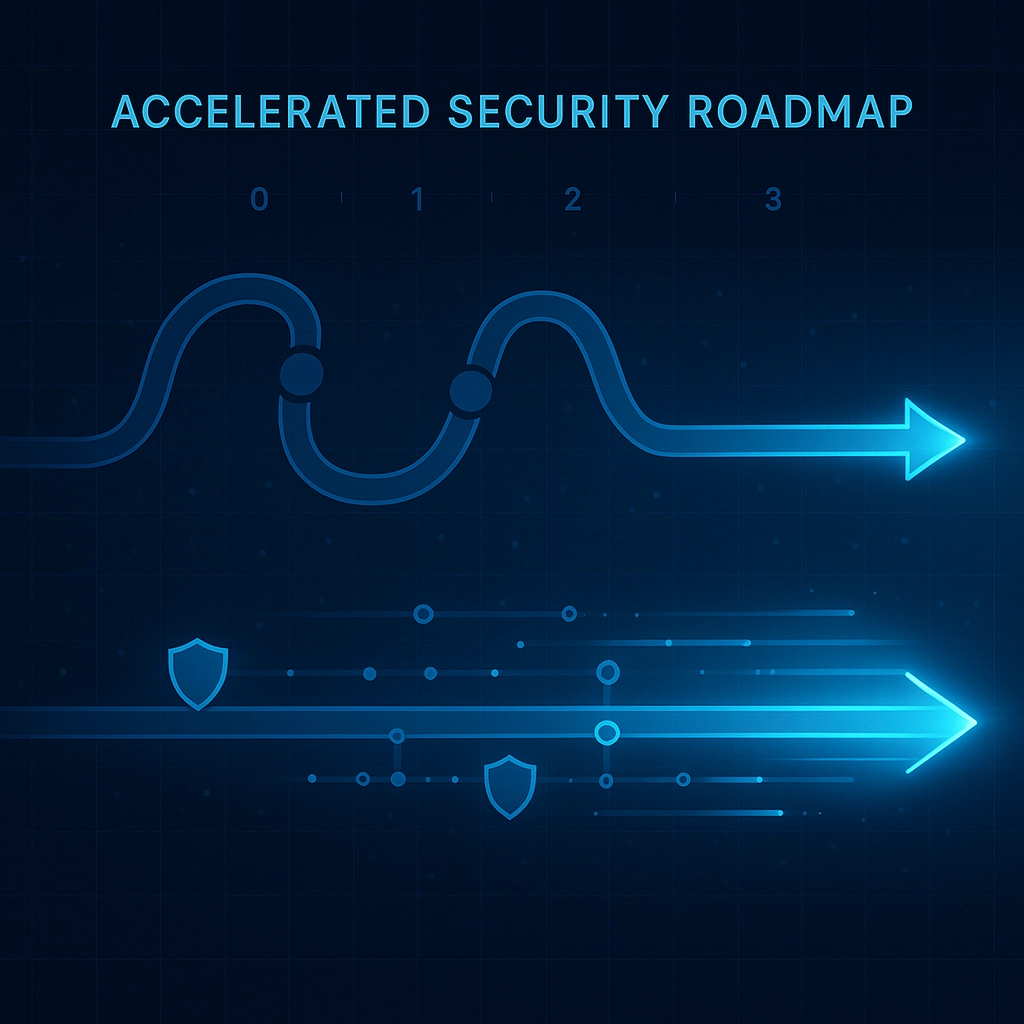
    Accelerated Security Program Maturation

    Organizations working with vCISOs typically report faster development of their security programs. Rather than building from scratch, a vCISO brings:

    • Tested frameworks and methodologies
    • Pre-built policies and procedures that can be customized
    • Efficient assessment approaches
    • Established vendor relationships

    One CyberLite client reduced their security program development timeline from 18 months to just 6 months by leveraging our vCISO's existing frameworks and resources.

    image_2

    Enhanced Risk Management and Compliance

    Regulatory compliance continues to grow more complex, with GDPR, CCPA/CPRA, HIPAA, PCI DSS, and industry-specific requirements creating a challenging landscape.

    A vCISO brings specialized compliance knowledge, helping organizations:

    • Map overlapping requirements to minimize duplicate efforts
    • Implement efficient compliance controls
    • Prepare for audits and assessments
    • Develop sustainable compliance programs

    For many organizations, this alone justifies the investment, as the average regulatory fine in 2025 exceeds $300,000 per incident.

    Strategic Security Alignment with Business Goals

    Perhaps the most valuable contribution of a vCISO is their ability to align security initiatives with broader business objectives. Unlike purely technical security professionals, experienced vCISOs understand how to:

    • Communicate security concepts to board members and executives
    • Develop risk frameworks that reflect business priorities
    • Build security programs that enable rather than hinder growth
    • Demonstrate security ROI in business terms

    This business-centric approach ensures security investments directly support organizational goals rather than operating in isolation.

    Case Study: Mid-Size Manufacturing Firm Transformation

    A manufacturing company with approximately 250 employees and growing international operations faced increasing customer security requirements and compliance challenges. With a limited IT team focused primarily on operations, they lacked dedicated security leadership.

    After engaging CyberLite's vCISO service:

    • They developed a comprehensive security roadmap aligned with business growth plans
    • Successfully passed customer security assessments, unlocking new revenue opportunities
    • Implemented efficient controls mapped to multiple frameworks (ISO 27001, NIST CSF)
    • Reduced third-party risk through improved vendor assessment processes
    • Created a security awareness program that measurably reduced successful phishing attempts by 87%

    Total annual investment: Less than 30% of what a full-time CISO would have cost, with broader expertise and faster implementation.

    The CyberLite Approach to vCISO Services

    At CyberLite, we've refined our vCISO offerings to address the specific challenges organizations face in 2025:

    Flexible Engagement Models

    We recognize that organizations have varying needs and budgets. Our vCISO services scale accordingly:

    • Advisory vCISO: Quarterly strategy sessions, on-call guidance, and program oversight
    • Active vCISO: Monthly onsite/virtual presence, hands-on program development, and leadership
    • Embedded vCISO: Weekly engagement, team leadership, and deep organizational integration

    Comprehensive Coverage Areas

    Our vCISO services encompass all critical security functions:

    • Security strategy and roadmap development
    • Risk assessment and management
    • Policy and procedure development
    • Compliance program management
    • Security awareness and training
    • Incident response planning and testing
    • Vendor risk management
    • Security technology selection and implementation

    image_3

    Measurable Outcomes and Reporting

    We believe security investments should demonstrate clear value. Our vCISOs provide:

    • Regular executive reporting with business-focused metrics
    • Compliance status dashboards
    • Risk reduction tracking
    • Security program maturity assessments
    • Clear documentation of all deliverables and activities

    Why 2025 Is the Year to Invest in vCISO Services

    The cybersecurity landscape has reached an inflection point that makes vCISO services more valuable than ever:

    1. Threat evolution is outpacing internal expertise: AI-driven attacks, supply chain compromises, and advanced persistent threats require specialized knowledge.

    2. Compliance requirements continue to multiply: New regulations emerge regularly, with existing ones frequently updated.

    3. Security talent remains scarce: The gap between available security professionals and open positions continues to widen.

    4. Cost pressures demand efficiency: Organizations need to maximize security ROI while minimizing overhead.

    5. Board-level security oversight is increasing: Directors and executives demand greater transparency and accountability for security investments.

    A vCISO addresses each of these challenges, providing strategic leadership without the constraints of traditional employment models.

    Conclusion: Security Leadership for the Modern Enterprise

    As we navigate through 2025, one thing is clear: cybersecurity is too important to leave to chance, yet too expensive for many organizations to address with traditional hiring models. The vCISO approach represents the ideal middle ground—providing executive-level security leadership tailored to your organization's specific needs, budget, and risk profile.

    At CyberLite, we're committed to making world-class security leadership accessible to organizations of all sizes. Whether you're looking to establish a security program from the ground up, mature existing capabilities, or navigate complex compliance requirements, our vCISO services deliver measurable value without the overhead of traditional hiring.

    Ready to explore how a vCISO could transform your security posture? Contact our team today to schedule a consultation and discover the CyberLite difference.