It’s April 2026, and if you’re running a growing company, your morning coffee probably tastes a lot like "regulatory compliance" and "AI-driven phishing threats." The cybersecurity landscape has shifted faster than most of us expected. Gone are the days when a simple firewall and an "employees-only" Wi-Fi password were enough to keep the bad guys out.
Today, security isn't just a technical problem for the IT guy in the basement, it’s a business strategy. But here’s the dilemma: you need senior-level security leadership to navigate these waters, yet you might not have the $300k+ lying around to hire a full-time Chief Information Security Officer (CISO).
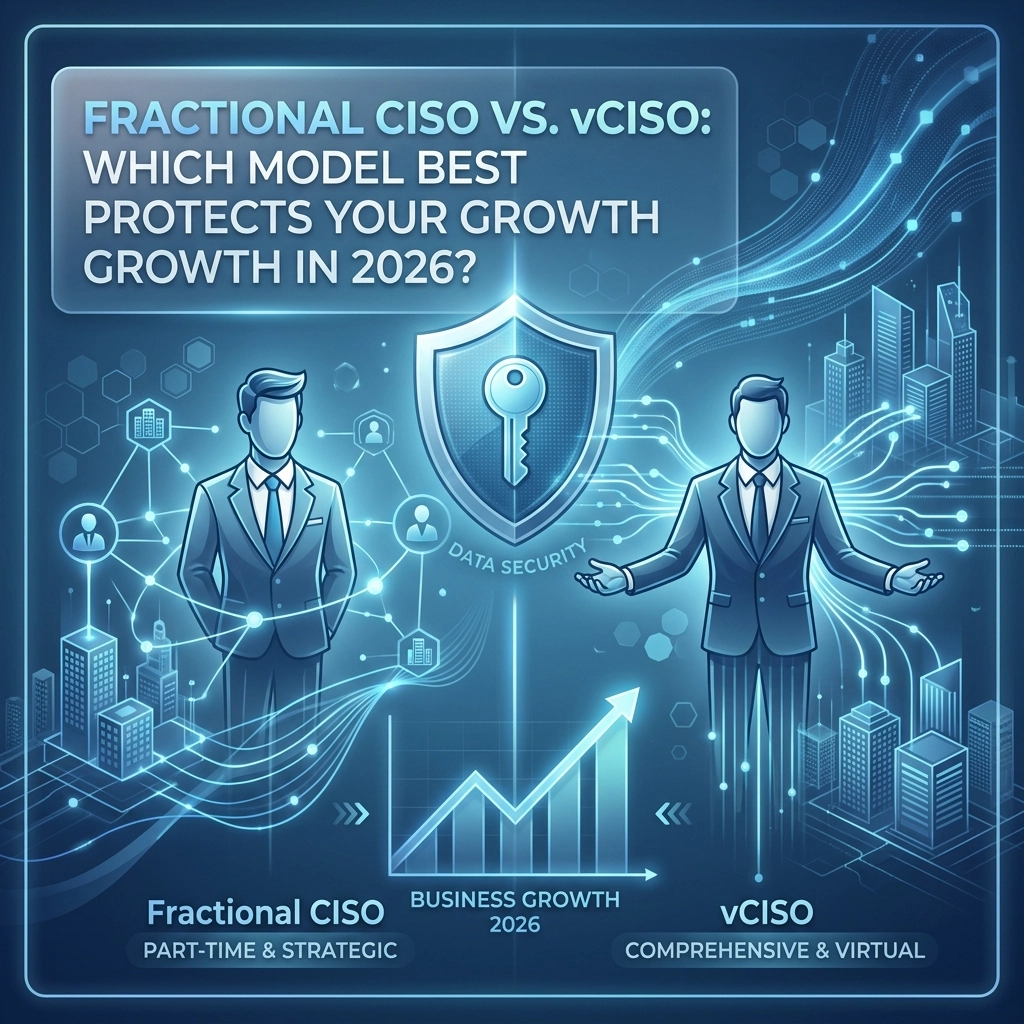
This is where the terms "Fractional CISO" and "vCISO" (Virtual CISO) come into play. People often use them interchangeably, but as we head further into 2026, the subtle differences between these models can determine how well your business scales, and how well it survives a breach.
The Identity Crisis: What’s the Difference?
If you search for these terms online, you'll find a lot of jargon. Let’s strip that away and keep it simple. Both models provide part-time, expert-level security guidance without the full-time price tag.
What is a Fractional CISO?
Think of a fractional CISO as a part-time executive who is truly "in" your company. They don’t just show up for a meeting once a month; they own a "fraction" of your security leadership. They are often embedded in your management meetings, they know your team by name, and they take a hands-on approach to building your security roadmap.
In 2026, a fractional CISO is often the preferred choice for companies that need a "named" leader to show to investors or regulators, someone who feels like a member of the C-suite, just for 10 or 15 hours a week.
What is a vCISO?
A vCISO (Virtual CISO) is often more service-oriented. You’re typically hiring an agency or a firm (like us here at CyberLite) to provide strategic oversight. It’s highly flexible. You get the collective brainpower of a whole security operations center (SOC) rather than just one person’s perspective. It’s perfect for organizations that need high-level strategy and compliance checkboxes handled without needing a "face" in every weekly management huddle.

Why 2026 Demands Strategic Leadership (Not Just Tools)
We’ve seen it a thousand times: a company buys five different security tools, installs them, and thinks they’re safe. Then, a sophisticated AI-driven social engineering attack hits, and those tools don't know how to react because no one set the strategy.
The reality is that tools are just hammers. You still need an architect to build the house. Whether you choose a fractional CISO or a vCISO model, you are paying for that "Architect" role.
At CyberLite, we’ve shifted our focus to what we call the Weekly Authority Engine. It’s not about just "checking for updates." It’s about providing expert strategic leadership that evolves every single week. In 2026, hackers aren’t resting, so your strategy shouldn't either.
Comparing the Models: A Quick Breakdown
| Feature | Fractional CISO | vCISO |
|---|---|---|
| Integration | Deeply embedded in company culture. | Remote-first, service-level focused. |
| Perspective | Single expert’s deep experience. | Multi-expert, agency-wide knowledge. |
| Flexibility | High, but limited by one person's time. | Extremely high; can scale up/down instantly. |
| Cost | Usually a monthly retainer for set hours. | Often project-based or tiered subscriptions. |
| Best For | Series B+ startups or mid-market firms. | SMBs and companies with episodic needs. |
The "Fractional CISO" Advantage in a Hybrid World
One reason the fractional CISO keyword is trending so heavily in 2026 is the rise of the specialized, "plug-and-play" executive. As businesses become more modular, hiring someone who has "been there, done that" at a Fortune 500 company to spend one day a week on your security posture is a massive competitive advantage.
It’s not just about stopping hacks; it’s about winning deals. Your customers are asking for SOC2 compliance, ISO 27001, and proof of AI safety. A fractional leader can sit across the (virtual) table from your biggest prospect’s legal team and say, "I’m the CISO, and here is how we protect your data." That closes deals.
How to Choose the Best Model for Your Growth
Choosing between these isn't about which one is "better", it's about which one fits your current shoe size.
- Check your headcount: If you have 50–500 employees but zero dedicated security staff, a fractional CISO is your best bet. You need someone to actually build the department.
- Check your budget: If a full-time CISO salary would take up 20% of your total operating costs, you’re in the "fractional/virtual" sweet spot. You get the same brain for 1/5th of the price.
- Check your complexity: Are you dealing with high-intensity AI implementations? Check out our thoughts on securing AI in the enterprise. If your tech stack is complex, you need someone who provides more than just a monthly report.

The CyberLite Way: Beyond the Label
At CyberLite, we don’t get hung up on labels. Whether you call it a fractional CISO or a vCISO, what we provide is Strategic Leadership. We’ve found that the most successful companies in 2026 are those that combine expert guidance with automated defense.
Our services are designed to bridge the gap. We provide the "authority" that a fractional CISO brings, backed by the scalable resources of a virtual team. This means you don't just get a consultant who gives you a "to-do" list and leaves; you get a partner who helps you execute.
The 2026 Security Checklist for CEOs:
- Audit your current leadership: Who is actually responsible if a breach happens tomorrow?
- Review your compliance: Is it a "checkbox" or a "shield"?
- Assess your AI risks: Are your teams using AI tools that leak company data? (See our AI defense blog for more).
Final Thoughts: Growth Requires Protection
You can’t build a skyscraper on a foundation of sand. In 2026, security is that foundation. Whether you opt for a fractional CISO to be your right-hand leader or a vCISO to provide a broad safety net, the key is to stop treating security as a "cost center" and start seeing it as a growth engine.
Ready to see where your gaps are? Don't wait for an incident to find out.
[CTA] Book a security assessment with CyberLite today and let’s build your 2026 roadmap.
LinkedIn Post
Headline: Is your security leadership stuck in 2023? 🛡️
In 2026, the gap between "having tools" and "having a strategy" is where most breaches happen. For growing companies, the question isn't whether you need a CISO, it’s how you hire one.
I’m seeing a lot of confusion between the Fractional CISO and vCISO models.
The short version?
🔹 Fractional CISO: A part-time executive embedded in your team. Perfect for growth-stage startups needing a "face" for investors.
🔹 vCISO: A flexible, service-based model. Great for SMBs needing high-level strategy without the C-suite price tag.
At CyberLite, we focus on providing the strategic leadership that actually moves the needle, ensuring your security posture supports your growth instead of slowing it down.
Which model are you using to protect your scale this year? Let's discuss in the comments. 👇
#Cybersecurity #FractionalCISO #vCISO #BusinessGrowth #CyberLite
Email Snippet
Subject: Fractional or Virtual? Which CISO do you actually need?
Hi [Name],
As we navigate the security challenges of 2026, one thing is clear: you can’t manage today’s threats with yesterday’s "part-time IT" mindset.
Most CEOs I talk to know they need senior security leadership, but they’re torn between a Fractional CISO and a vCISO. Is there really a difference?
In our latest blog post, we break down the nuances of these two models and help you decide which one best protects your company's growth. We also dive into why "strategic leadership" is the most important asset you can buy this year.
[Read the full breakdown here: Fractional vs. vCISO]
If you're ready to stop guessing and start securing, we’re here to help.
Best,
Clifford Vazquez
CEO, CyberLite
Sales Objection Card
Objection: "A fractional CISO is just an expensive consultant who gives me a list of problems I already know I have."
The Response: "I hear you: there’s nothing worse than paying for a 'to-do' list. But a true fractional CISO isn't a consultant; they’re an operator. Unlike a consultant who drops a report and disappears, a fractional CISO owns the outcomes. They don't just tell you that you need better encryption; they sit in your product meetings to ensure it’s built-in, and they handle the tough questions from your board or enterprise customers. They aren't an expense; they’re an insurance policy for your revenue."
Proof Angle: Highlight a case study where a CyberLite fractional leader helped a client clear a complex security audit (like SOC2) in half the expected time, directly resulting in a major contract win that paid for the service 10x over. Point to our services page for more on how we execute.
Leave a Reply